Seminar on "The Crisis in the Banking Sector:Financial Reporting, Ethics, Governance Failure, and the Way Forward" Organized by the Department of AIS, BUP
03 Nov 2026
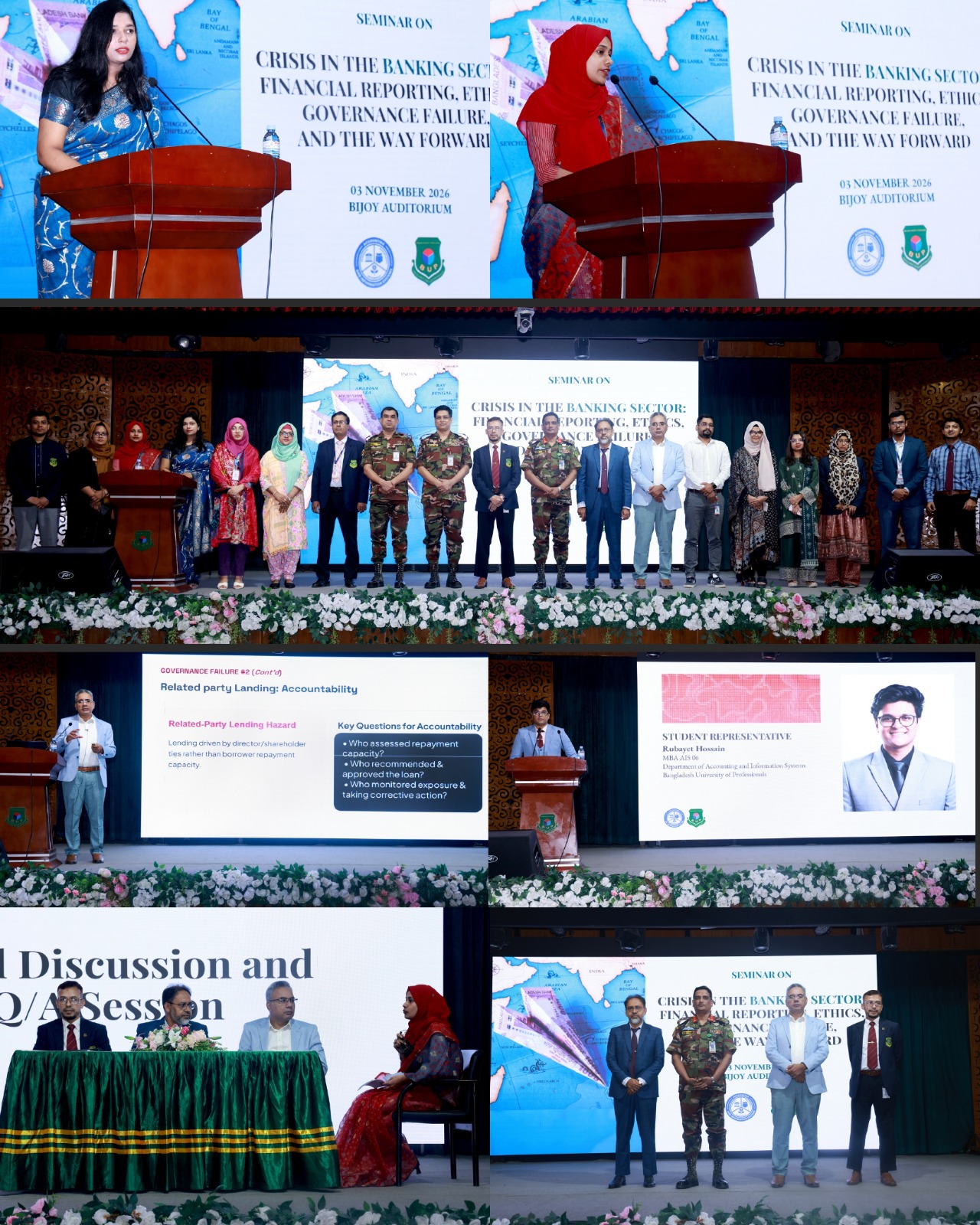
The Department of Accounting and Information Systems, Bangladesh University of Professionals (BUP), organized a seminar titled ‘The Crisis in the Banking Sector: Financial Reporting, Ethics, Governance Failure and the Way Forward’ on 3 November 2026 at Bijoy Auditorium, BUP. The seminar aimed to give students a deeper understanding of the causes and implications of the ongoing banking crisis, with particular emphasis on the role of financial reporting, professional ethics and corporate governance in ensuring accountability and institutional integrity.
Mohammad Anisur Rahman, Director of the Islamic Banking Regulations and Policy Department of Bangladesh Bank, delivered the keynote address. Dr. Mohammad Kamal Hossain, ACCA, Associate Professor and former Dean of Jashore University of Science and Technology, who holds a BSc (Hons) in Applied Accounting, an MBA (UK) and a PhD (UK), gave a panel presentation. Lt Col Md. Ferdausur Rahman, MPhil, PhD, AEC, Associate Professor and Chairman of the Department of Accounting and Information Systems, BUP, also delivered a panel presentation. The honourable Dean of the Faculty of Business Studies (FBS), Brigadier General Md Aminul Akbar Khan, AWC, AFWC, PSC, MPhil, graced the occasion as the Chief Guest.
The seminar began with an opening speech by the moderator, Assistant Professor Farjana Nur Saima, who welcomed the guests on behalf of the department. Reflecting as both a graduate and a teacher of accounting, she questioned why banking crises persist despite regulations, governance codes, audits and committees. She noted that rules alone cannot guarantee ethical conduct, as good governance also requires effective enforcement, accountability, leadership and integrity, and encouraged participants to engage actively in the discussion. The seminar then continued with a speech by Md. Rubayet Hossain, an MBA student of the department, who welcomed the guests on behalf of all students. He noted that a financial statement is a promise of truth to people who cannot look inside a bank, and expressed hope that his fellow students would choose honesty over comfort when their integrity is tested.
Lt Col Md. Ferdausur Rahman highlighted the role of accountants in the crisis, with the central message that when accountants fail, everyone suffers, from depositors and shareholders to the state and honest businesses. He showed how weaknesses in loan classification, provisioning, auditing and disclosure kept bad loans hidden, and linked accountants’ ethics to the Qur’anic values of trust, honesty and justice.
Dr. Mohammad Kamal Hossain examined whether the crisis stems from economic uncertainty or governance failure. He noted that ten banks hold over 72% of non-performing loans, while 13 private banks kept theirs below 5%. He identified weak board independence, credit approval, committee oversight and enforcement as key failures, concluding that governance failed despite existing rules because of weaknesses in design, implementation and enforcement.
The keynote speaker, Mohammad Anisur Rahman, explained that reported NPLs rose from 9% in December 2023 to 32.78% in June 2026, reflecting a failure built over fifteen years through opaque reporting, ethical lapses and institutional weaknesses. He proposed a way forward based on truth in reporting, loss allocation, accountability and strong institutions, stressing that lasting government commitment, free of political interference, will decide the outcome.
The programme proceeded to a panel discussion and an open question-and-answer session, moderated by Assistant Professor Farjana Nur Saima. Students raised important questions on the recovery of non-performing loans, ongoing reform programs and the future direction of the banking sector, which the speakers addressed. The seminar ended with a concluding speech by the Chief Guest, Brigadier General Md Aminul Akbar Khan, AWC, AFWC, PSC, MPhil, Dean of the Faculty of Business Studies, BUP.